
Why Europe’s Latest Fiscal Rupture Is a Global Prelude
When Sonal Desai, Global Chief Investment Officer at Franklin Templeton Fixed Income, warned that the escalating French bond rout risks triggering a Eurozone debt crisis “version 2.0”, one that could eclipse the original Greek blowup of 2012, financial markets were forced to confront a reality they had long preferred to ignore. For over a decade, European policymakers treated fiscal recklessness as a peripheral pathology, a weakness restricted to the Mediterranean fringe. By contrasting the core’s structural stability with the South’s fragility, the continent maintained a fragile consensus. On the back of one-sided reforms, that consensus has now fractured . When the bond market turns to Paris, the illusion of an insulated core vanishes.
The immediate mechanics of the crisis are familiar enough to observers of European public finance. Yield spreads between French Obligations Assimilables du Trésor (OATs) and German Bunds have widened to levels unseen since the height of the previous sovereign crisis, driven by a national budget deficit exceeding 5.4 percent of gross domestic product and public debt hurtling past 120 percent. Yet the true gravity of Desai’s warning lies not in these immediate accounting shortfalls , but in the institutional paralysis that underpins them . With a fractured National Assembly incapable of passing structural spending adjustments, France faces an uncompromising dilemma: execute forced austerity under market duress or risk losing its anchor status within the European monetary architecture.
The word “compromise” does not exist in European politics.
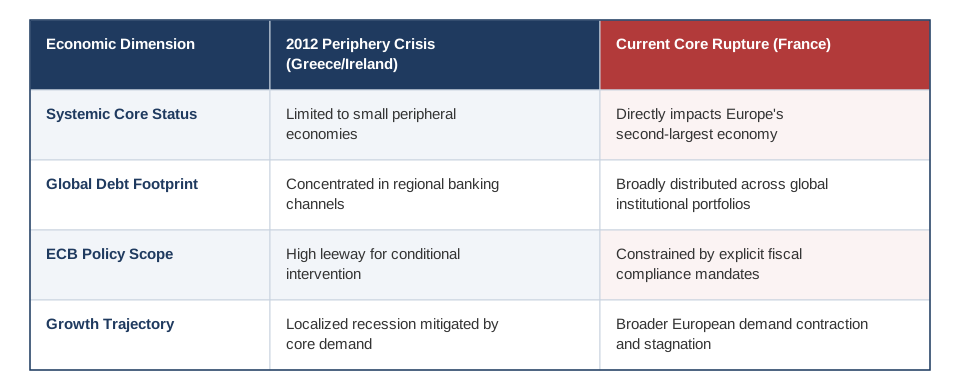
Technocrats and optimistic economists are quick to assemble the counter-arguments. They note that the European Central Bank now possesses a sophisticated array of anti-fragmentation tools, most notably the Transmission Protection Instrument (TPI) and flexible reinvestments under the Pandemic Emergency Purchase Programme (PEPP). Furthermore, unlike the structural current-account deficits that crippled Greece, Ireland, and Portugal fifteen years ago, France remains a wealthy, highly productive core economy deeply embedded in global trade networks.
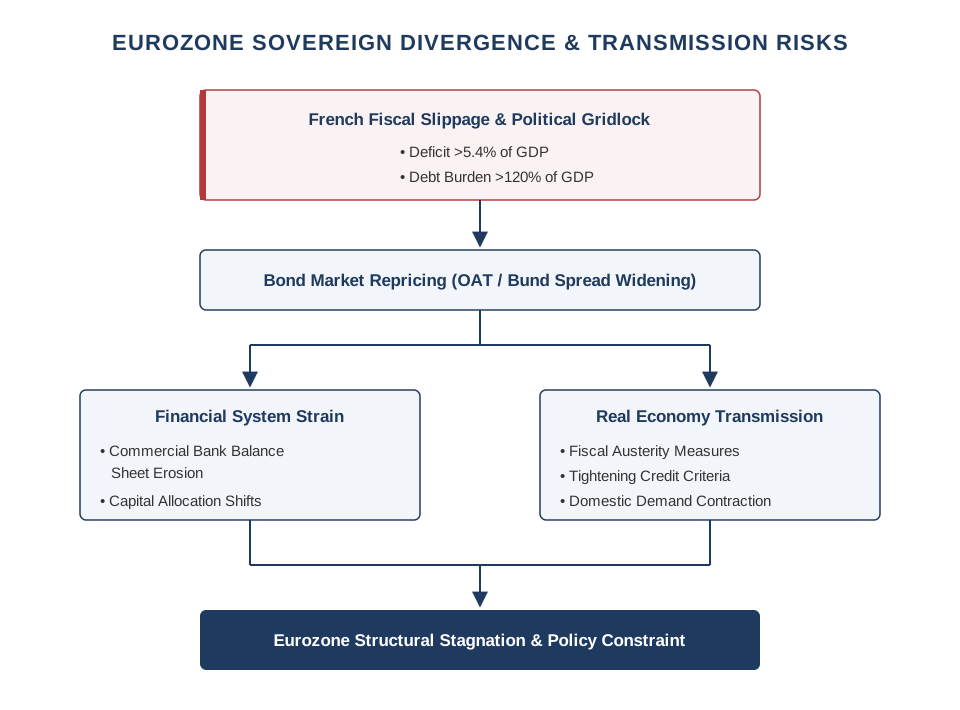
However, this optimism underestimates the harsh political reality now facing the continent. The ECB’s intervention mechanisms are explicitly contingent on compliance with strict EU fiscal frameworks, the very frameworks Paris is currently violating . To deploy monetary backstops to absorb French debt without imposing structural conditionalities would dissolve any remaining political legitimacy the institution enjoys in Northern Europe. Moreover, while peripheral economies could be subjected to external reform programs managed by external technocrats, imposing external budgetary discipline on the second-largest economy in the European Union is a political impossibility. Europe has once again navigated its way into a critical juncture, where the institutional machinery designed to maintain stability is rendered ineffective by political friction.
The economic fallout of this fiscal gridlock extends far beyond sovereign borrowing costs. As French yields climb, the capital buffers of commercial banks across the continent, which hold vast tranches of sovereign paper as primary liquid assets, face balance sheet contraction. The predictable corporate reaction is a tightening of credit conditions for small and medium-sized enterprises, driving private investment downward. When combined with the unavoidable fiscal consolidation required to placate bond markets, Western Europe faces a prolonged period of sub-par economic growth and structural stagnation .
The deeply ingrained resistance to structural reform across mature economies stems from a powerful convergence of psychological loss aversion, institutional path dependency, and explicit historical precedent. Psychologically, voters and political elites operate under “status quo bias” and severe asymmetry in perceived outcomes: the costs of liberalizing labor markets or trimming public entitlements, such as reduced job security or deferred retirement, are immediate, highly tangible, and borne by concentrated, vocal interest groups, while the economic benefits of long-term productivity growth remain diffuse, uncertain, and years away. Culturally and historically, particularly in France, the welfare state is not viewed merely as a macroeconomic safety net, but as a central component of the post-war social contract and national identity, a republican ideal of equality and social solidarity forged through centuries of revolutionary tradition that explicitly rejects purely market-driven allocation. Structurally, this creates a formidable “reform paradox”: hyper-centralized executive systems combined with fragmented parliaments, unable to compromise, mean that any attempt to dismantle fiscal protections triggers widespread civil unrest and political deadlock, leaving short-term tax adjustments and debt-fueled spending as the path of least political resistance until an external market crisis forces a reckoning.
This European predicament, however, is merely a symptom of a far more pervasive global malady. Across the developed world, sovereign balance sheets are overleveraged, burdened by aging demographics, rising debt-servicing costs, and expanding entitlements. From Washington to Tokyo, sovereign states have relied on persistent deficit spending to underwrite social contracts that their underlying productivity growth can no longer sustain.
The crisis unfolding in Paris serves as a stark reminder that monetary engineering cannot permanently compensate for structural economic stagnation. Wealth creation, rising real wages, and the funding of public infrastructure ultimately depend on expansion of the real economy. When real output growth stalls, sovereign debt ceases to be a bridge to future prosperity and becomes instead a tax on future generations. Unless the industrialized nations restore productivity growth as the primary objective of state policy, the market discipline currently reasserting itself in French bond markets will inevitably arrive on every major sovereign shore.
For a deeper strategic framework on how to interpret market signals and transform them into actionable decisions, you can explore my consulting approach at Rapid Clarity.